It has come to my attention that my blogs do not reflect back to my central argument as much as they could. This lack of cohesion is something that cannot be completely overcome due both to the episodic nature of the blog as a genre,as well as the more exploratory nature of this approach to an essay, however, I want to make it as cohesive as possible. To that end I want to explore what conclusions and arguments can be found in where I have already gone.
First I think we should start with something fairly simple like grouping together subjects by emotional content. First we have the dark sublime. I have discussed it previously but I will restate it here. It is, most simply, the darkness that we see inside ourselves magnified, which I discuss briefly here. It pairs well with the sentiments of terror and awe of nature that Edmund Burke discusses in the early approach to the sublime that I covered here. I also have discussed sickness (and zombies) and the precipice that sickness places you upon, confronting your own mortality here. These would all be what I would call dark emotions. Not necessarily bad emotions: self reflection after sickness, fear and respect of nature, and awareness of the potential darkness of the human soul are healthy conditions for feeling.
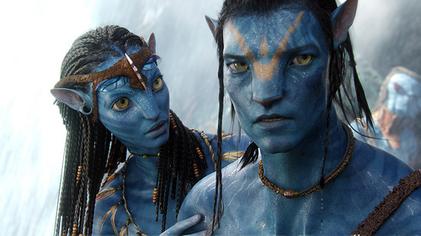
We also have the positive emotions. We have love in Avatar, as well as a host of other traits. We also have our view of mankind and emotion in relation to eternity (not sure this really counts as positive emotion) which I discussed in relation to Contact. I have also discussed faith, conversion, and religion in Contact in relation to the sublime experience.
What we can get out of this separation is first a small range of the human experience and emotion. I think that we can also argue that human emotion and experience has the power to be overwhelming and indeed sublime in any emotional form. We are capable of experiencing love, hate, grief, etc... to a degree that we cannot express. However, we have looked at a number of different modern examples of the sublime each very different. One of my classmates said that aestheticism and the sublime are considered to be dead in literature analysis. However, as long as it is this obvious that it continues to be a part of human emotion, how can we abandon it as a valid approach? What I find in the classic works of Emily Dickinson is more important because I can also find it in the modern works of art. My brother periodically asks my jokingly, "Who cares about Emily Dickinson?" If what was in Emily Dickinson was not relevant towards our current emotions today, then we could easily say that in full truth. So, why does Emily Dickinson matter, because all our emotions as humans continue to be relevant. Emily Dickinson was a recluse who still felt the full range of human emotions, from the view of her house she showed what we all feel.
This article is part of a continuing theme on Emily Dickinson, modern media, and the sublime, if you would like to know more read here.
Showing posts with label Avatar. Show all posts
Wednesday, June 16, 2010
Cohesion in Purpose
Labels:
Avatar,
Contact,
Edmund Burke,
emily dickinson,
emotion,
humanity,
sublime
Tuesday, June 1, 2010
Avatar Party - Avatar as a Sublime Experience?
I knew that I would most likely not have time to write in my blog on Friday, between going class and the Avatar party later my day was fairly full. I had intended to write Saturday, but my day was taken over by my friend Laura (not that that is a bad thing) and we made Julia Child's Beef Bourguignon, which we had been putting off for a while. Not surprising considering it involved more money and utensils then we probably should have paid for. Sunday is a day of worship and it just didn't feel right to write the blog on Sunday, not to mention helping my brother brainstorm for a new novel. And Memorial day was taken up by more of the novel activity, some housework I had put off, and of course, some getting together with friends and family.
So now its Tuesday and I'm finally getting back to my blog. Nothing like life to get in the way of everything else.
So we had the Avatar party last Friday on the 28th. We had Indian food for dinner and also watched some movie scenes from India. I am tempted to say Bollywood, but these videos were actually from southern India which lead to a few cultural difference that Professor Burton pointed out to us. Avatar is in many ways about the difference between cultures and some culture shock. I think that was echoed fairly well with my classmates as we watched the movies from India. There was an element that felt off, a part of our perceptions that said that this should not be this way, that should be different, etc... And while it is not the main thing that I want to talk about in regards to Avatar, it occurred to me that being exposed to cultures which strike you in this way could be a form of sublime. I think it is a lesser sublime, but for a time your mind is expecting a different action and consequence than it gets. Culture is a way of seeing the world, and expose to a new culture is a new way of thinking that is at first beyond your comprehension. And what could be more sublime than that which the mind is not yet ready to comprehend?
Avatar is not just a single sublime experience. Like any good book or movie it may have a central argument but that is not its only one. It is a sublime of the power and glory of nature, as well as natures raw beauty. It is about the war within mankind that has been going on since the beginning, not only of good and evil but also of moving forward or moving back, and mankind's simultaneous fear and acceptance of the new. It is about religion and God's interplay with nature. It is as I had mentioned also about the conflict between points of view and separate cultures. It is also about identity and about the self verses or between two societies (more than that really, we have the scientists who form another separate culture). It is also very much a love story, and it may be questioned whether the main character, Jake Sully can be considered to be truly one of the Na'vi because of their ideals or because he was in love with Neytiri (though his later experiences are very like a conversion story in which he becomes converted to the nature religion of the Na'vi). It is about military and civilian, and how those modes of thought differ, though it is fortunate that it does not make the mistake of saying one or the other is evil. It is about how money can be an end in itself, and when it becomes the most important thing everything else can be sacrificed for that. There is also the question of honorable war, and what it is and is not worth going to war for.
There are more that I could go into. I think what I really wanted to demonstrate is that the sublime is part of the human experience. Most humans go through love at some point, but who really understands all that it means to love? Love as a matter of fact is one of the perfect examples of the sublime, because it is supposed to be about giving yourself over to something larger than yourself, without necessarily knowing why. The sublime with it state of being that which we do not understand because it is bigger than the human experience can hold, is however, still very much a part of what it means to be human. So it really should not surprise us that we find it across art. The issues may change, the very sublimes that we encounter may change their image, but the sublime is as much a part of our culture now as has always been.
So now its Tuesday and I'm finally getting back to my blog. Nothing like life to get in the way of everything else.
So we had the Avatar party last Friday on the 28th. We had Indian food for dinner and also watched some movie scenes from India. I am tempted to say Bollywood, but these videos were actually from southern India which lead to a few cultural difference that Professor Burton pointed out to us. Avatar is in many ways about the difference between cultures and some culture shock. I think that was echoed fairly well with my classmates as we watched the movies from India. There was an element that felt off, a part of our perceptions that said that this should not be this way, that should be different, etc... And while it is not the main thing that I want to talk about in regards to Avatar, it occurred to me that being exposed to cultures which strike you in this way could be a form of sublime. I think it is a lesser sublime, but for a time your mind is expecting a different action and consequence than it gets. Culture is a way of seeing the world, and expose to a new culture is a new way of thinking that is at first beyond your comprehension. And what could be more sublime than that which the mind is not yet ready to comprehend?
Avatar is not just a single sublime experience. Like any good book or movie it may have a central argument but that is not its only one. It is a sublime of the power and glory of nature, as well as natures raw beauty. It is about the war within mankind that has been going on since the beginning, not only of good and evil but also of moving forward or moving back, and mankind's simultaneous fear and acceptance of the new. It is about religion and God's interplay with nature. It is as I had mentioned also about the conflict between points of view and separate cultures. It is also about identity and about the self verses or between two societies (more than that really, we have the scientists who form another separate culture). It is also very much a love story, and it may be questioned whether the main character, Jake Sully can be considered to be truly one of the Na'vi because of their ideals or because he was in love with Neytiri (though his later experiences are very like a conversion story in which he becomes converted to the nature religion of the Na'vi). It is about military and civilian, and how those modes of thought differ, though it is fortunate that it does not make the mistake of saying one or the other is evil. It is about how money can be an end in itself, and when it becomes the most important thing everything else can be sacrificed for that. There is also the question of honorable war, and what it is and is not worth going to war for.
There are more that I could go into. I think what I really wanted to demonstrate is that the sublime is part of the human experience. Most humans go through love at some point, but who really understands all that it means to love? Love as a matter of fact is one of the perfect examples of the sublime, because it is supposed to be about giving yourself over to something larger than yourself, without necessarily knowing why. The sublime with it state of being that which we do not understand because it is bigger than the human experience can hold, is however, still very much a part of what it means to be human. So it really should not surprise us that we find it across art. The issues may change, the very sublimes that we encounter may change their image, but the sublime is as much a part of our culture now as has always been.
Subscribe to:
Posts (Atom)